
Not All Annuities Are Trying to Do the Same Job
People talk about fixed index annuities as if they're a single product. They aren't. The label covers a wide range of contracts, and the differences between them are not cosmetic. They reflect fundamentally different jobs that the money is being asked to do.
In my last piece, I wrote about a client, Rene, who owned a perfectly reasonable annuity that nobody had matched to her actual goals. That piece focused on the process failure: the missing conversation that should have come before the product. This piece is the other half of that story. Once you understand what you actually need, it helps to understand what the products on the shelf are built to deliver, so you can recognize whether what you own (or what you're being shown) fits the job you need done.
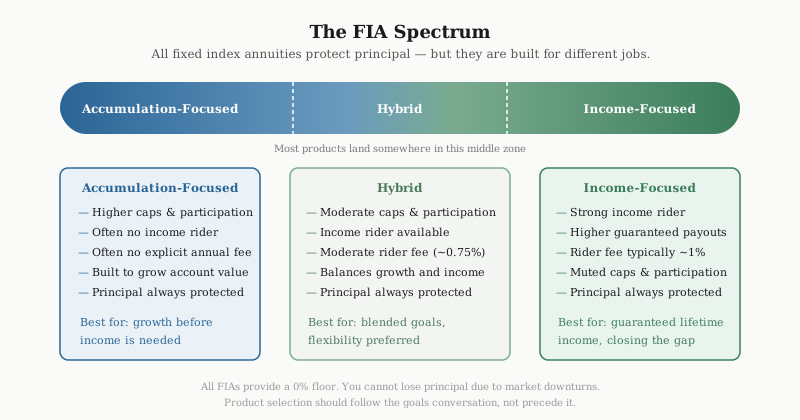
Think of the FIA category as a spectrum. On one end, contracts are built almost entirely for income. On the other end, contracts are built almost entirely for accumulation. In between, a wide middle ground where most products and most people actually land.
The Income-Focused End
At this end of the spectrum, the contract is built around one goal: producing reliable income you cannot outlive. Everything else is secondary.
These contracts typically include a guaranteed lifetime withdrawal benefit, sometimes called an income rider. This is the feature that calculates a separate "income base," distinct from your actual account value, and grows it at a guaranteed rate until you decide to start taking withdrawals. Once you turn on income, the insurance company pays you a percentage of that income base for life, regardless of what happens to the underlying account value.
The tradeoff is on the growth side. Income-focused contracts tend to have muted caps and participation rates, meaning the credited interest you earn in years when the index performs well is capped at a lower level than you'd see on a contract built for accumulation. You're also typically paying an explicit rider fee for the income guarantee, commonly in the neighborhood of 1% annually, deducted from the income base or account value, depending on the contract.
Hypothetical illustration: Income-focused contract
Premium: $350,000. Age 65, income deferred 10 years.
Income rider fee: ~1.00% annually
Income base growth rate during deferral: 7% simple, compounding-style credit
Resulting income base at age 75: ~$595,000
Payout rate at age 75: 5.5%
Resulting guaranteed lifetime income: ~$32,700/year
Cap rate on growth: muted, e.g., 2-4% annual cap
This contract is designed to answer one question well: how do I create a paycheck I can't outlive? If that's the job, the muted growth potential is the price of certainty, not a flaw in the design.
The Accumulation-Focused End
At the opposite end, the contract is built to grow your money with principal protection, full stop. There's often no income rider at all, and in many cases, no explicit annual fee. The insurance company makes its money on the spread between what it earns on your premium and what it credits to your account, not through a stated fee line.
Because there's no income guarantee to fund, these contracts can offer meaningfully stronger caps and participation rates. Some have no cap at all on certain index strategies, instead using a participation rate that determines what percentage of the index's gain you receive. The appeal here is straightforward: tax-deferred growth, a 0% floor so you never lose principal due to market downturns, and the potential for more attractive credited interest in good years, all without paying for an income feature you may not need yet.
Hypothetical illustration: Accumulation-focused contract
Premium: $350,000. Age 55, no income rider, no fee.
Participation rate: 80%
Average annual credited interest over a 10-year period (illustrated, not guaranteed): 5.5%
Resulting account value at age 65: ~$598,000
This is the right tool for someone who doesn't need income now and may not need it for years, but wants the growth potential of index-linked returns without market downside. If the job is "grow this safely until I need it," this end of the spectrum is built for exactly that.
The Hybrid Middle Ground
Most products, and most clients, live somewhere between these two ends. A hybrid contract typically includes a moderate income rider, with a fee somewhat lower than that of most income-focused products, paired with caps and participation rates that are better than those on the income-heavy end but not as strong as those of pure accumulation products.
This isn't a compromise in the negative sense. For a lot of people, the actual goal is itself a blend. Maybe you want the option of guaranteed income down the road, but you're not certain you'll need it, and you'd rather not give up too much growth potential to fund a feature you might never use. A hybrid contract is a deliberate response to that kind of need, not a failure to commit to either side.
Hypothetical illustration: Hybrid contract
Premium: $350,000. Age 60, income rider included but not yet activated.
Income rider fee: 0.75% annually
Participation rate: 65%
Income base growth rate during deferral: 5%
Resulting income base at age 70: ~$525,000
Payout rate at age 70: 5.0%
Resulting guaranteed lifetime income if activated: ~$26,250/year
Account value growth if income is never activated (illustrated, not guaranteed): comparable to a moderately capped accumulation product
This is, structurally, the kind of product Rene owned. Decent income potential. Decent growth potential. Built to be a reasonable fit for a wide range of people, which is also exactly why it isn't automatically the best fit for any specific person. A hybrid contract works well when your goals are genuinely blended. It works less well when your goals are clear and lopsided toward one end of the spectrum, and you end up paying for features you don't need or missing out on growth you could have captured.
Note: The figures above are illustrative only, based on assumptions consistent with current market conditions. Actual contract terms, payout rates, and credited interest will vary by carrier and product. Any annuity purchase should be evaluated using a formal illustration from the issuing carrier for the specific contract being considered.
Mechanics Serve the Goal, Not the Other Way Around
None of this is complicated once you see it laid out. The income-focused end trades growth potential for guaranteed income. The accumulation-focused end trades income guarantees for stronger growth potential. The hybrid middle trades a little of each for a product that can flex in either direction.
What determines which end of the spectrum belongs in your plan isn't which one sounds better in a seminar room. It's the answer to the questions I wrote about in the last piece: what this money is for, when you need income, and how much of your guaranteed income gap is already covered elsewhere.
Once you know the answer to those questions, the spectrum stops being confusing. It becomes a map. You're not choosing the "best" annuity in the abstract. You're choosing the contract whose tradeoffs match the job you actually need done.
That's the whole point of understanding the mechanics. Not to turn you into an annuity analyst, but to give you enough clarity to recognize whether the product in front of you was chosen for your goals, or whether your goals were assumed to fit the product.
For more on how FIAs work and where the common criticisms miss the mark, start with my earlier piece about why and when I like them, and my piece about Rene. If you want to keep thinking through these questions, The Pensioner's Paradox lands in your inbox every other week.